New Technologies

The Centro Force Redesign Origin:

For years we have been waiting for new Sennheiser innovation, since it's first iteration of the HD800 in 2009..

Imagine in 2009 the HD800 was simply an engineering marvel, so way ahead of its time that even with the 2015-2016 800S release, it still looked space age.

The point is that it took a genius engineer, Axel Grell, who was able to think “outside the box” to create such an engineering marvel.

So with the loss of this engineer, it took this same “outside the box” thinking, in order to achieve what has never been thought possible with the HD800S. A "restoration" to the design, not simply an addition, as it will “restore” hidden potential beyond what was conceptually intended. Transparency & Realism was the goal and accomplishment with this “Centro Force” design.. Not just any change in “signature” sound.

10yrs later and amazing coincidence (or destiny) for me (Charles) and Vince (whitigir) to get together and combine our “outside the box” engineering ideas, which synergistically transformed and evolved the HD800 original design into a new, never before explored mod, neither by Sennheiser nor ANY other modder, continuing in an evolution to what we believe Axel Grell's design would have intended.

With this redesign, we will finally see the fruition and goal of the full potential that the HD800s design was truly capable of.

Greater Potential in Frequency Response, phase, and linearity for all HD800 variants.

The Theory Behind The New Centro-Force "Technical Upgrade" :


The New “Centro-Force” design implementation basically introduces two new aspects (two-fold):


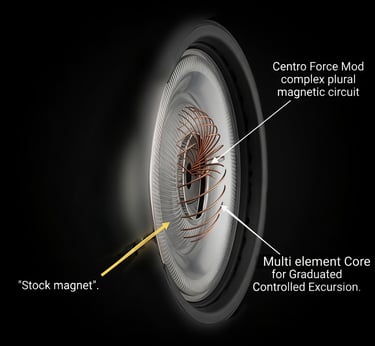
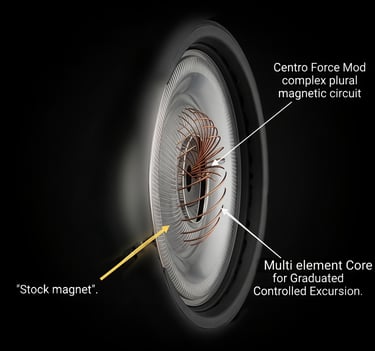
1- First, the Ground breaking new implementation of Plural magnetic elements. What we named as the “Trinity core”. It combines triple magnetic field structures into “unified core” of varied intensity, according to the driver’s excursion.

With this new manipulation, we can control dynamics, soundstage, and every other measurable aspect of driver performance. The "trinity core" is an advanced core, designed to last indefinitely, longer than the lifetime of the headphone, without any change or loss in efficiency and exacting performance. Upcoming kits (for technically inclined) will show the multi-element design complexity.

This is the frontal redesign:

2- Second, A New rear design :

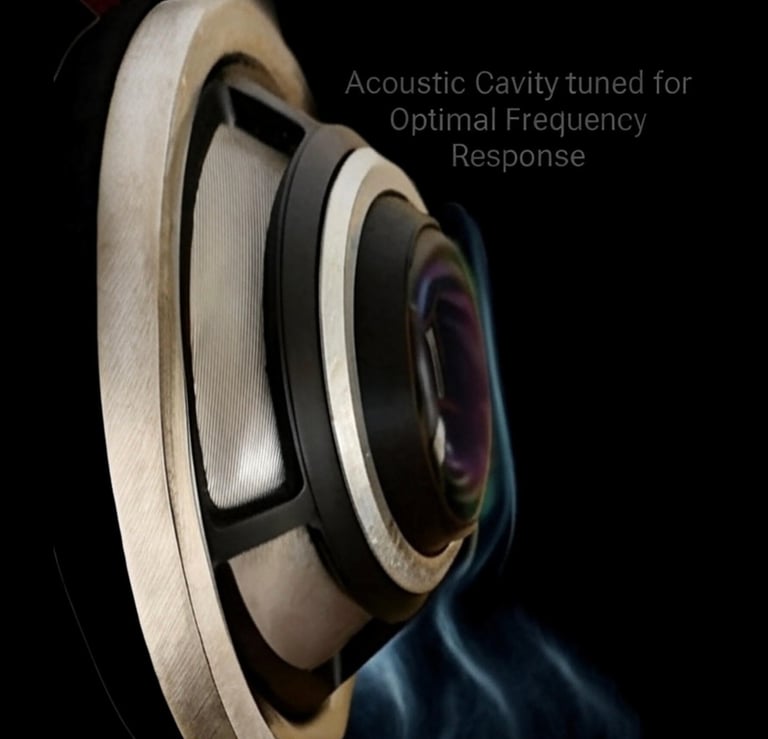
A new rear “Acoustic reinforcement waveguide cavity” and baffle design, for uniformly reshaping the whole spectrum, elevating the Frequency Response “preference boundaries”. This new part consists of specific design angling, size, and "micro groove dispersion" to carefully control Frequency Response, Phase, Peaks, and dips(!). Uniquely preserving the soundstage openness (holography) that many previous mods and remakes have reduced or destroyed.

Important to note is that No "material tunning" is used in this design change...

The focus was on actual design improvements, so All improvements are of technical design origin.

This is not a "tuning mod", so this departs from traditional methods and thinking.

So there is no stifling or destructive signature changes from using strange added on sticky materials, “resonators”, or covering pieces, which are all basically post-design ideology that past attemps from other sources had.

Technical Specifications:

HD800 & 800S CF Measured Results below:

For greater familiarity to consumers, we chose to display our results on the popular REW program, that many are more familiar with..

Along with the overall increase of the low range, we also restored more liveliness in the 5-6khz area, along with a welcomed gentle dip in the usual sensitive 8-9khz area. Then we have an leveled off extension above 10khz for proper "air" (explained in bottom "ideologies" section). The gradual lowest dip at 3.5k simulates the HD800 level, to preserve the soundstage depth, because of the increase in "pin-point focus" & clarity. This is due to the clean up of mid-level ringing distortions (explained in waterfall measurements). So here we have what we feel is the perfect signature created by true design performance.

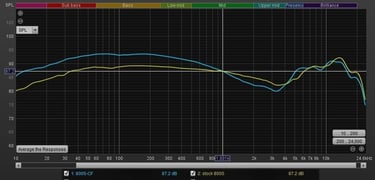
**HD800S-CF Improved Frequency Response:

For the HD800CF, we see how the whole bass region elevated and more linear. Even sub-bass can now be perceivable, as it is all above the white line (1khz reference level).

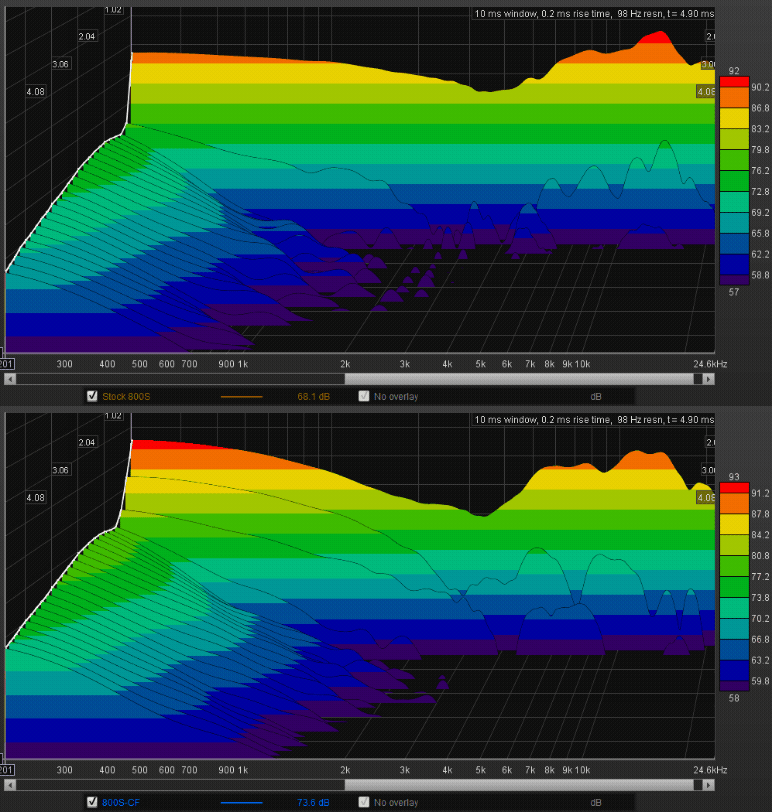
Next, the CSD/Waterfall plots:

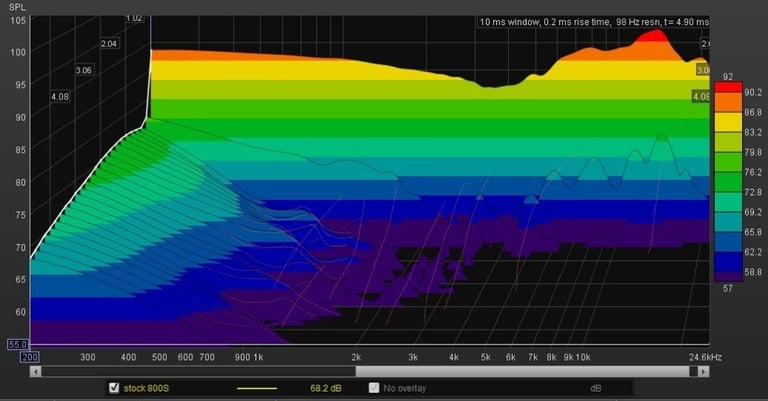
Standard measurements go down 35db for easier viewing of differences.

Here is the Stock HD800S, at about 35db down:

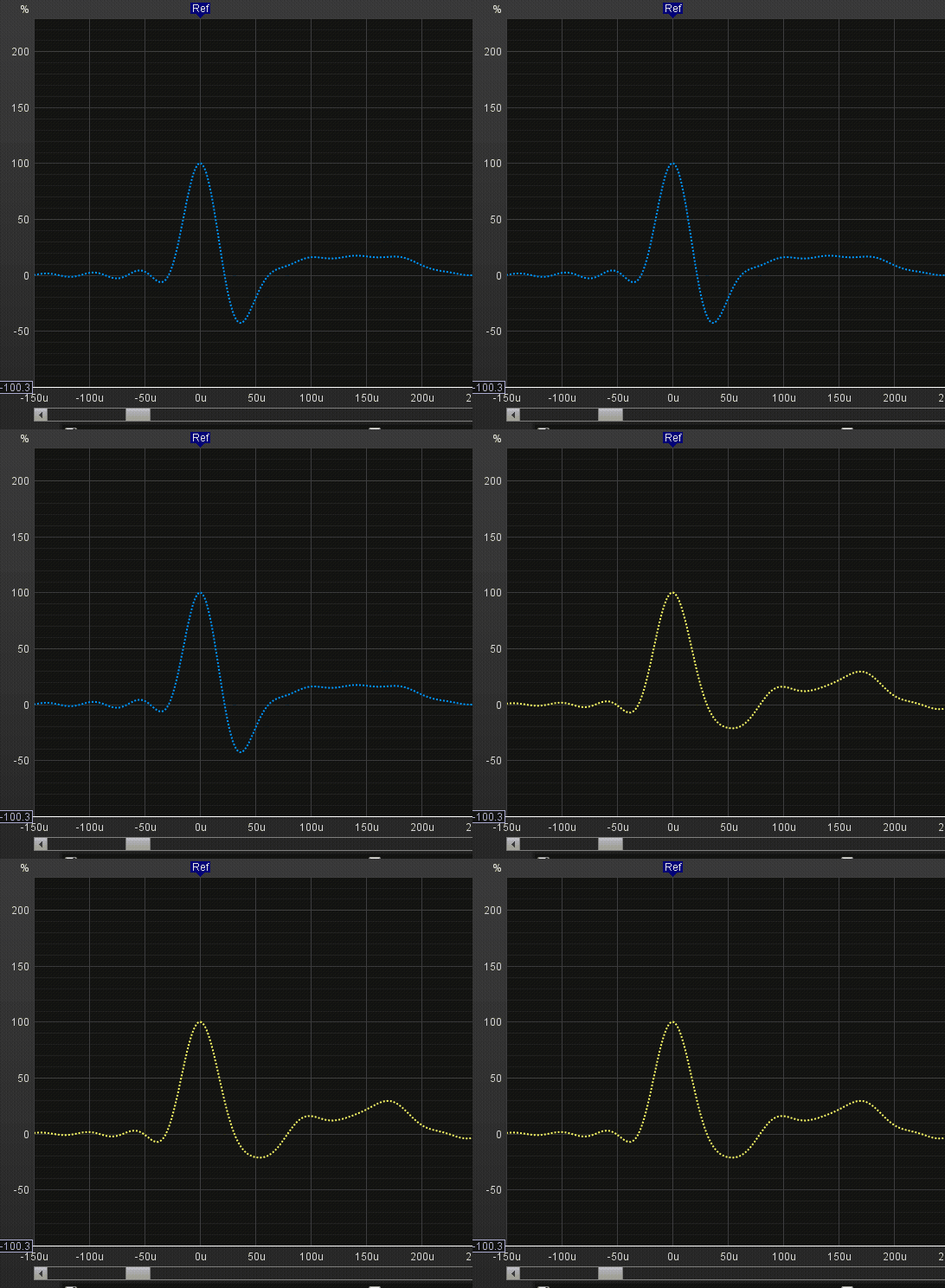
Here we see this Centro-Force version of the HD800 impulse (in blue):

We will now explain what our own testing has revealed, not "common engineering" or the recent "everything is EQ camp" consensus explanations, but key points revealed...

**The peak rise time before the "0" vertical is the actual speed.

**After the "0" is the decay, which reveals multiple aspects.

**The "normalization ability" is the decay time to rest at zero. This involves things like diver control and "air impedance".

** The negative travel of this impulse has an association with image depth & solidity.

**Anything after the completion of initial wave are artifacts like basket reflections.

So in this image we are noticing faster impulse time, and ridiculously well controlled decay… This translates to both driver speed and control has increased, which leads to better clarity and resolution.

The Sennheiser HD800 variants were true to the legacy of being one of the best headphones in the world, and now with the Centro Force Mod, it will be proven yet again to definitely be one of the best in the world. We can't thank Sennheiser enough for giving us this diamond we have just made brilliant.

For those who prefer the HD800 (not "S") sound, we see the HD800CF version eliminate the stock treble peaks & dips (causes of phase shifts), with the whole treble area leveled and restored well into the “air” region (at the 1khz white reference line),

This trebles extension rise after the 8-9khz area of sibilance sensitivity, according to how our hearing diminishes. Audibility of the “air region" (the missing aspect of most headphones today) is now restored. 

Lastly, lets look at the impulse response:

First off, the Bass:

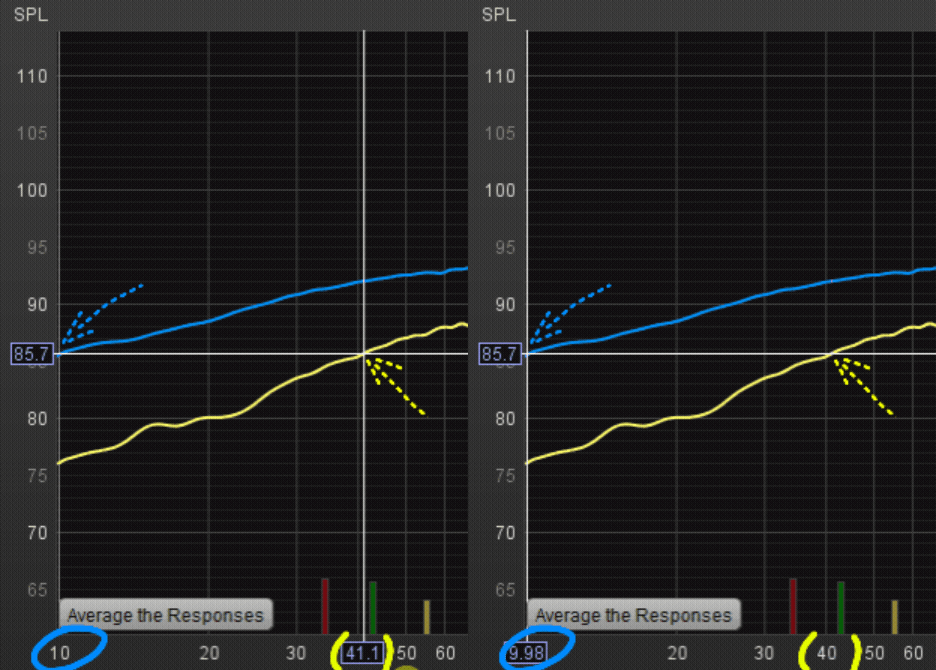
Here we see (on 800CF) a 9db increase @ 10hz (extreme sub bass). While this isn't evident in actual music (as normal mid-bass frequencies are around 60 HZ), this increase represents the scale of mechanical improvement in its driver's control.

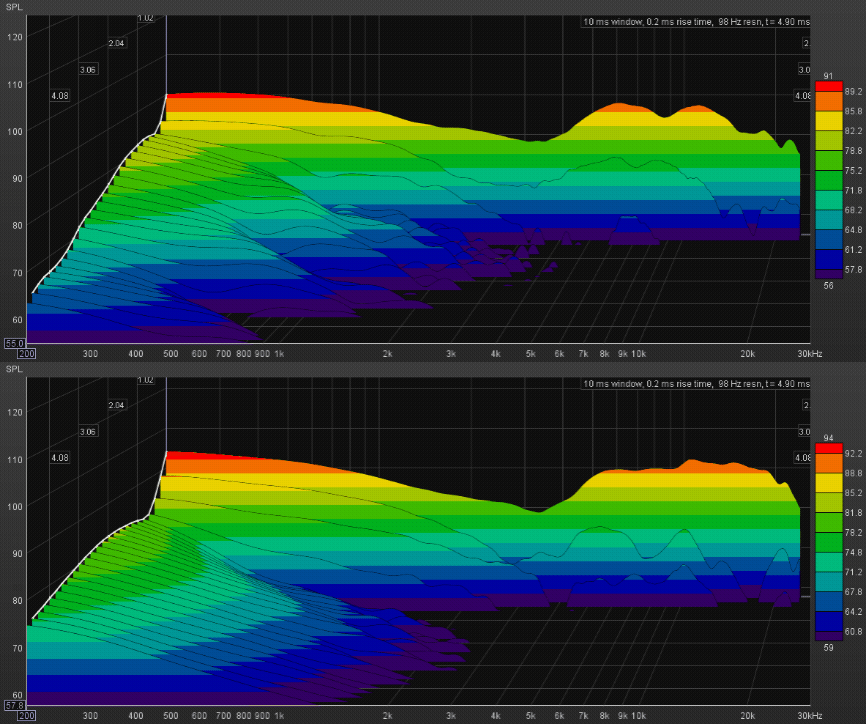
Below we show a "before and after" of the HD800 version, showing similar issue of ringing decays above 2.5khz, which are all gone with the "CF" Mod.

The lack of all ringing (trailing peaks) after 1.5 milliseconds leads to insane level of clarity and pin-point imaging.

For the 800S, a lesser 5db increase @ 10hz is observed, but regardless, but both 800CF & 800S-CF retain a sustained increase of 4-5db across the whole bass & "low mids" region, which adds up to a quite noticeable improvement, and a huge benefit the sound signature's natural bass ability. This presents a realistic native bass level which is very different than artificial EQ boosting. (artificial EQ issues explained at bottom page "Ideologies"). The cumulative amount represents an increase of over 72% of the overall bass spectrum. This increase in sensitivity shows how it is no longer be "amp dependent”, or bound to home desktop” setups.

Notice we marked the peak trails on the waterfall plots (thin red lines), which represent multiple rows of lower-level "ringing" in key multiple frequency areas.

This audibly translates to the diffuse soundstage and artificial spaciousness that plagued these headphones with less focused image placement as a result.

These peak "trails" are about 25-30dB down, which is easily discernible to the human ear (diffuse sound), as the human ear sensitivity typically hears details 60-70db below the peak. This sensitivity is even greater with headphones, and more so with IEMs.

This is where the "Centro-Forcce" mod distinguishes itself from ALL other modifications, with the elimination(!) of these ringing, to produce a clarity of notes in space, that was unachievable before:

HD800S-CF version:

Here we see (thin red lines) no vertical "red mrked" rows of peaks, and a sharp cut off of any trails. The bass is showing gradual downward slope with little ripple, unlike the stock image ripples.

The result is a much clearer/deeper soundstage, with nuances in music fleshed seemingly out of nowhere.

Here is a quick "before & after" comparison.

Ideologies

Importance of headphone goals

Many people in the headphones community have been trained to worry about peaks, but in reality most headphones today don't have major peaks that can't be fixed. The real issue, is the unresolved “dips”.

Having large dips "outside" of the ear’s sensitivity area (midrange) causes a more perceptive loss in music information.

For example, detailing within the midrange area can still be perceived inside dips, but dips outside of midrange area (especially in the trebles), will cause a general loss of resolve and realism..

Looking at this general chart below (which is not mine and I forgot the source):

A word About sibilance, EQ, and our different approach:

The causes of sibilance is not commonly focused on, but much of sibilance can be attributed to spurious peaks from phase shift issues, which typically manifest in the Trebles area .. Frequency extension in this area is an aspect few headphone companies will focus on, yet is critical for faster transients, which allows for pristine clarity and dynamics in the trebles, without the traditional harshness associated in this region attributed to sibilance.

Phase shifts issues derive from many sources like comb filtering, all EQ & EQ apps, improper digital filters used in devices, even improper usage of opamps in audio gear. All can lead to issues, but one of the main issues is the inability to differentiate slight treble echo and spacial reflections, causing parasitical phase shift peaks. These peaks are parasitic to all the latest measurement rigs that use ear & pinna in the coupling device, so the peaks may not even be from the headohones, This is why we take many measurements and positions of the headphones. Regardless, Peaks are both fast and dynamic, so require a faster transducer which can handle higher dynamics.

So it is critical for the headphones to be clean and free of distortions and phase issues in this area (5-8khz), so as to have less audibly pronounced sibilance. So ideally, the solution is not about making corrections with dips to the EQ.

Having less FR dips & peaks = less phase issues.

Combined with the speed of a fast impulse & decay, with increased dynamic range for least distortion, and we get as ideal as possible to eradicate any production of sibilance, without loss of actual sound information in this spectrum from FR dips.

Phase variance in the 5-8khz "Sibilance" area, is the main reason why manufacturers don't want to deal with this, and simply cut off the whole "sibilance" area with a dip in frequency response, so you end up with MISSING information. This is where Centro-Forcce design departs from the rest, by tackling this issue head on, resulting in notably superior performance in the "Sibilance" area, giving a clarity not seen before on these and most other headphones.

Think about it. In the real world, not having headphones on, we perceive all trebles without any need for EQ "dips".

All EQ adjustments inherently add some minor phase shift issues, even "linear-phase" EQ. So theoretically All EQ will contribute to slight masking of the sound. For audiophiles, this translates to less realism..

Instead of EQ, we would ideally like the headphone’s native Frequency Response to fall within the proposed Target Curves.

This further eliminates the need to add any EQ processing "after the fact", which contributes to these issues.

The modern day solution of needing digital EQ, is a sign of poorly designed headphones.

The Centro Force design is the solution to this.

For this example, we use the HD800CF. Take note that the midrange region was unaltered(!) and preserved, so that only the bass & trebles “preference regions” were expanded.

The importance of "preference boundaries" are 100% observed in Centro-Force design. The bass and treble elevations fall within the latest proposed equalization standards and target curves for upper treble, according to the AES E-Library, and also with more recent “preference boundaries”, set by others in online headphone communities.

AES E-Library Target:

Next, the Frequency Response “Target Curves”

we see what sensory information is missing(!), wherever there's a dip in that specific area.

Place any headphone FR in that graph, and you will see what information will be lost, where there is a dip.

This is why a majority of headphones today will have less sense of realism than they should. Even this image states so. This is also why our "CF" revision restores the areas above 10khz for greater quality reproduction.

Next: Importance of the upper spectrum (it's not just about the bass):

The extension of the frequency response beyond 10k not only improves transients but is also diminished in human hearing. This illustration below, shows why a "V" shape curve is preferred, in order to offset our loss of auditory sensitivity. So as to hear everything without effort.

How we attained our measurements...

Many newer measurement rigs such as the BK5128 (Brüel & Kjær Type 5128 our favorite) have a similar difficulty with accuracy issues above 8k, due to their "couplers".. Various ear and pinna models, microphone placement, and headphone positioning all contribute to "Non-compensatable" artifacts, so we specifically sought to address this.

Our measurement "coupler" is a hybrid.

It is composed of an Aggregate of concentric materials varying in density, absorbtion, and refraction at different points, designed to simulate the ear "without" the errors of artificial ear structures or fabricated pinna depths.

Therefore we bypass the problems of having spurious peak errors, while still emulating human ear response, which, in our view, results to achieving a more true reproduction of what the human ear perceives. For us, hybrid couplers are the future of headphone measurements.

Our Measurement rig has been initially modeled closely to the BK 5128 (wich we believe is best choice for headphones), and then further optimized to show a "more reliable" extended response to 20khz, while being less "busy" or having less "non-compensatable" (non-audible) treble data results, that the newer rigs display.

Let us compare. Here is an HD800S measurement from a reliable/trusted source, using the BK5128:

Now here is our stock HD800S measurement superimposed and combined exactly to scale:

We can see here our changes of measuring further into the bass and trebles extremes, and with a treble result that looks like an avg of the BK's response, which is what we feel is more approximate to what the human ear would actually hear.

As for the bass, our system is only showing a 2dB less response in bass region. So the BK system would have measured more bass than what we have stated to achieve!

Regardless, you can see very close results, but as with all setups, we must also treat the treble range beyond 9khz, mostly as an "approximate reference" rather than an absolute measurement.

Now that we shown how we measure, lets more onto the other topics related to the Centro-Force Mod.

FAQs

Will kits be made available?

SOON TBA... Yes, a future release is coming soon, but we also strongly recommend this for the technically inclined.

Currently, our designs are for NIB, which is a well thought out pricing structure that is more sound, logical, and safe, avoiding the time, labors and possibly costly ($300) driver mistakes. Drivers which are currently not being stocked as before.

Who is it for?

Audiophiles desiring a higher sound quality then what current HD800S can offer. Those seeking musically involving headphone experience.

Where can I buy Centro-Force headphones?

You can order directly from Authorized dealership on front Page.